Separate an external leak from internal bypass, understand what each of the four seal types does, and avoid ordering by machine model
A practical guide to excavator hydraulic cylinder seal kits: why ordering by machine model fails, what the rod seal, wiper, piston seal and wear ring each do, how to tell an external leak from internal bypass, the four most common fitting mistakes, and the five measurements to send with an enquiry.
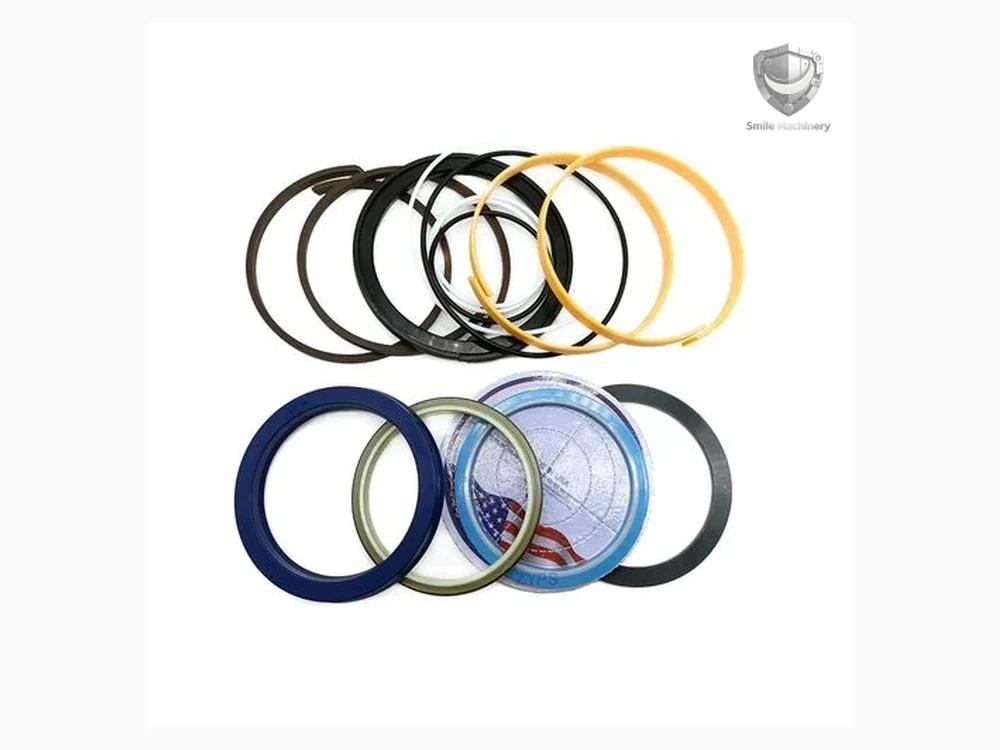
A cylinder seal kit usually costs a few percent of a complete cylinder assembly. It also decides whether that assembly keeps working. We regularly see cylinders that were mechanically sound, resealed with the wrong kit, leaking again within weeks and then written off as scrap.
The problem is almost never the quality of the seals. It is the selection. Seals are dimensional parts, and a few tenths of a millimetre in the wrong direction is enough for a kit to fit badly or not at all.
One more item is frequently missed: the buffer seal. It sits ahead of the rod seal and flattens pressure spikes. Many kits do not include it, and it is usually found damaged only after the cylinder is open.
This is where most wrong orders start. The same machine model can carry cylinders from different suppliers depending on build period, and on one machine the boom, arm and bucket cylinders are three different sizes. Order a "CAT 320D cylinder seal kit" and there is a good chance it is not the cylinder you are holding.
The reliable method is to measure four things: bore diameter, rod diameter, and the diameter and depth of the seal cavity in the gland. Add the part number stamped on the cylinder assembly if it is still readable. With a part number the match is straightforward; without one, these four measurements carry the identification.
One practical note: measure with a caliper, not a tape. A millimetre of error is the difference between a seal that fits and one that either will not enter the groove or will not seal in it.
Internal bypass is often misdiagnosed as a pump or main valve problem. A simple check: take the cylinder to the end of its stroke against a load and watch how pressure builds and how fast it drops. A clear drop with a dry exterior is strong evidence of bypass.
1. Machine model and serial number
2. Cylinder assembly part number, stamped on the barrel or on its plate
3. Bore diameter and rod diameter, measured with a caliper in millimetres
4. Cylinder position: boom, arm, bucket, steering or other
5. Fault description: external leak or internal bypass, and whether the chrome is damaged or the cylinder is noisy
A photograph of the gland helps as well. With the cavity cross-section visible we can confirm the seal profile and cut down the back-and-forth before quoting.
Once the dimensions and part number arrive we check three things before quoting: whether the seal profile matches the gland cavity, whether the material suits the working temperature, and whether the kit needs to include the buffer seal and wear rings.
Kits shipped to Russia, Kazakhstan and Uzbekistan travel with a seal position diagram and a fitting sequence note. Seals installed the wrong way round are the most common workshop error, and one clear diagram prevents most of the rework.
WhatsApp / Phone: +8615319433340
Telegram: +8613609129500
Email: [email protected] / [email protected]
