What seepage, noise and a worn flange each mean, and why rollers should never be mixed new with old
A practical guide to excavator track and carrier rollers: the three stages of wear and what each sounds and looks like, how a floating seal differs from a lip seal in muddy conditions, why rollers on one side should be replaced as a set, and the five details to send with an enquiry.
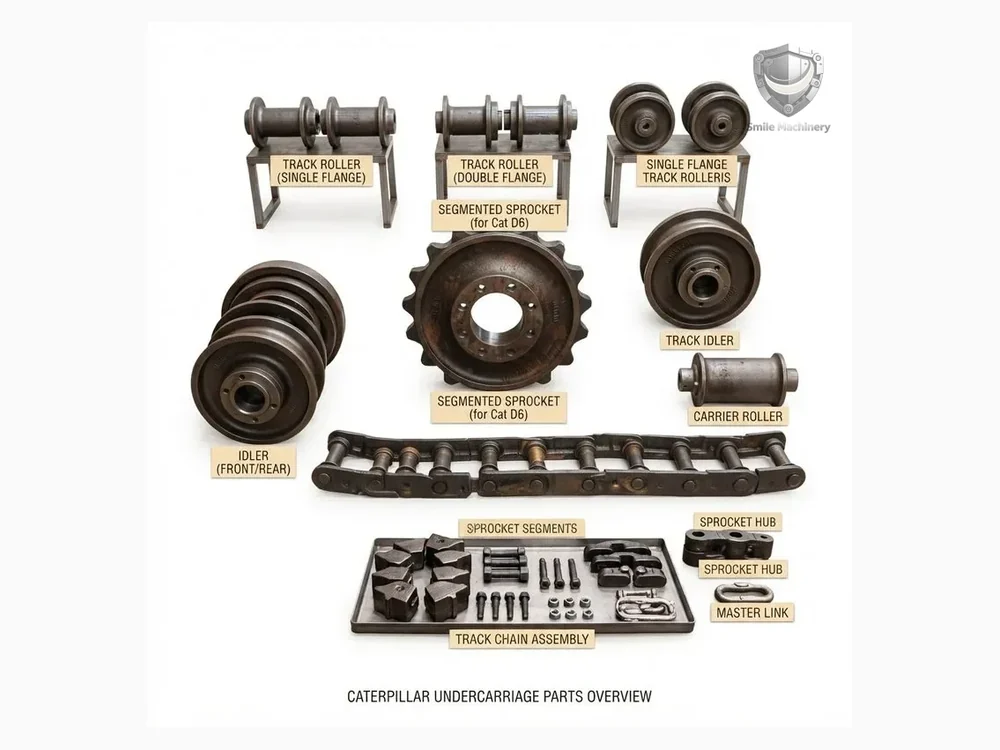
A 20-ton excavator carries roughly seven track rollers per side plus two carrier rollers, close to twenty pieces in total. They carry the whole weight of the machine, work immersed in mud and water, and absorb impact every time the tracks move. Of all the undercarriage parts they are replaced most often, and most often left until something fails.
The reason is practical: one leaking roller does not stop the machine working. By the time it does, the track chain and the drive sprocket are usually damaged as well.
Outside diameter can be checked without dismantling. Measure across the shell with a caliper and compare with the nominal figure. More than three to four millimetres of loss means replacement is due. A reduced diameter changes tension distribution along the whole chain, and the neighbouring rollers start wearing unevenly.
The meaningful difference between rollers is not the shell steel but the seal arrangement. There are two common types:
Two rollers can look identical and share the same mounting dimensions while the internal seal arrangement is completely different. That is usually where a large price difference comes from. In muddy conditions a low-cost lip seal may last a third as long as a floating seal.
This is the most common and most expensive mistake in undercarriage maintenance. A new roller has a larger diameter than a worn one, so on the same chain every roller sees a different wrap angle and the load concentrates on a few. The new roller fails early and the old ones fail faster.
The practical rule: either replace all rollers on one side as a set, or group them by wear and keep new and old on different sides. If only one or two have failed, choose replacements whose diameter is close to the average of that side.
Most rollers today are greased at manufacture and sealed for life. Some retain a plug so grease can be topped up. The sealed type needs no attention but cannot be rescued once the seal fails. The greaseable type needs one more maintenance step and can last longer.
Which one suits depends on the application. For continuous mud and slurry work the greaseable type has more tolerance for abuse. For dry gravel work the sealed type is enough.
1. Machine model and serial number
2. Part number stamped on the side of the roller
3. Quantity and position, including whether carrier rollers are needed
4. Working conditions: mud and water, dry gravel, quarry or general earthworks
5. Current condition: seeping, noisy, worn flat, or preventive replacement
With the part number we confirm mounting dimensions, seal arrangement and nominal diameter against the original before quoting. Rollers are not always interchangeable between positions on the same machine, so quantity and position need to be stated together.
Rollers shipped to Russia, Kazakhstan and Uzbekistan go out on pallets or in crates with rail transit of about 25 to 40 days. Shipping a full set from one batch keeps diameters consistent, and that matters more to undercarriage life than unit price does.
WhatsApp / Phone: +8615319433340
Telegram: +8613609129500
Email: [email protected] / [email protected]
